
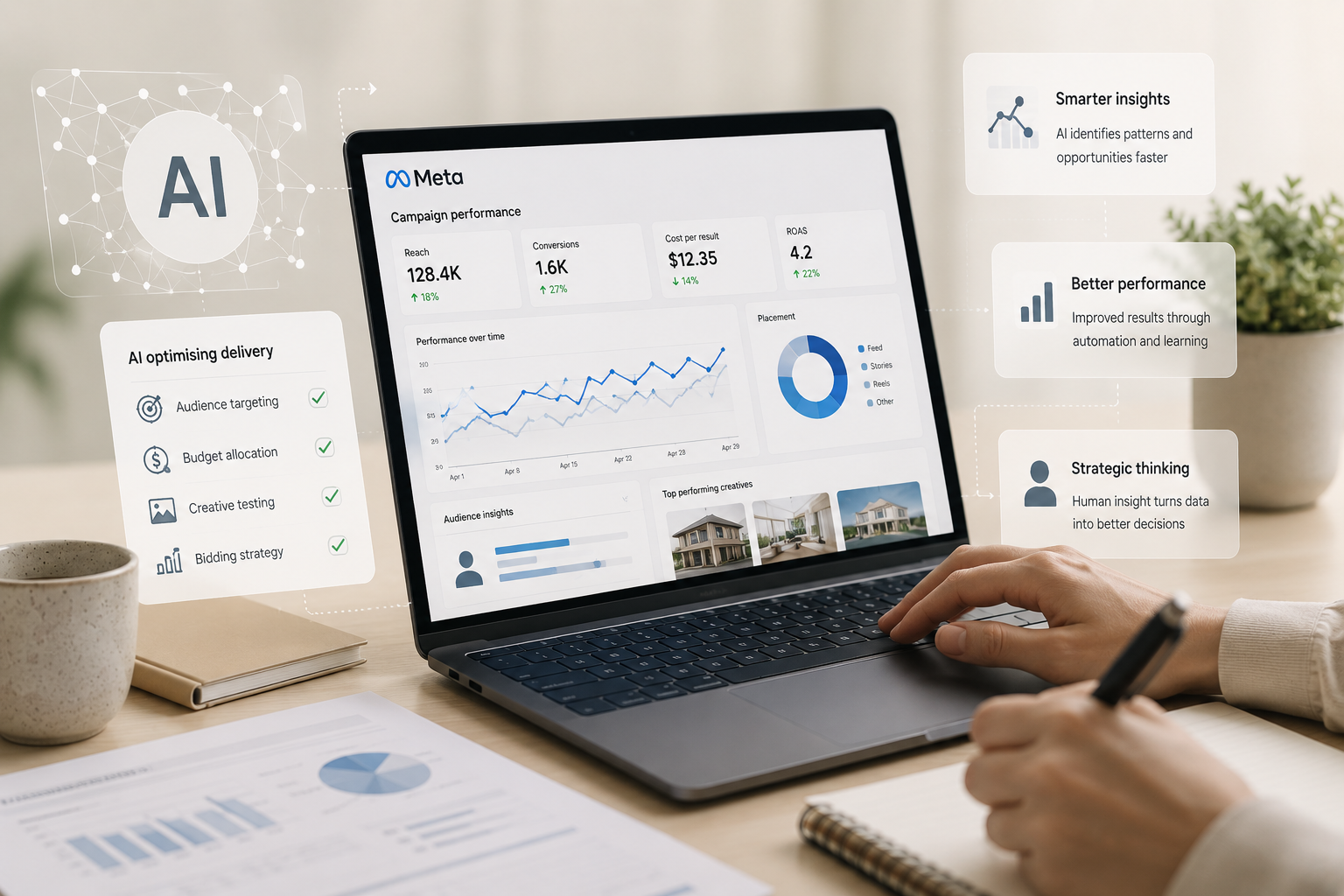
Artificial intelligence is changing the way Meta advertising works.
Campaigns are becoming more automated. Instead of manual targeting, audiences are now being identified through machine learning. Budgets are adjusted in real time. Even creative assets can be assembled in a dynamic way. Advertisers now have access to tools that promise greater efficiency with less manual intervention.
For many marketers, the question is no longer whether to use AI. It’s how to use it well.
Across the campaigns we manage for property developers and builders, we are seeing genuine improvements in campaign performance through Meta's AI-powered tools. We are also seeing where AI reaches its limits.
While the technology is evolving quickly, the fundamentals of good marketing are not.
AI is making campaign delivery smarter
Meta has invested heavily in automation through features such as Advantage+ audiences, automated placements, campaign budget optimisation and AI-driven creative delivery.
These tools analyse thousands of signals in real time to determine who is most likely to respond, where ads should appear and which creative combinations are likely to perform best.
In many cases, they outperform highly manual campaign structures.
Rather than narrowing audiences too early, AI can identify opportunities that advertisers may never have considered.
We have seen campaigns generate quality enquiries from audience segments that would not have been selected using traditional targeting alone.
The lesson is simple. Sometimes the algorithm sees patterns that people cannot.
Better technology does not fix weak strategy
One of the biggest misconceptions about AI is that it can solve every marketing problem.
It cannot.
If the positioning is unclear, the messaging is generic or the offer lacks relevance, AI simply delivers the wrong message more efficiently.
We have seen campaigns where changing the audience produced little improvement. The real breakthrough came after refining the customer proposition.
The campaign was speaking about land size, location and inclusions.
Customers were making decisions based on lifestyle, certainty and future value.
Once the messaging reflected what mattered to buyers, campaign performance improved significantly without major changes to targeting.
AI optimised the delivery.
Strategy improved the outcome.
Creative matters more than ever
Meta's AI works best when it has options to learn from.
Providing multiple headlines, images, videos and copy variations gives the platform more opportunities to identify what resonates with different people.
This does not mean creating more content for the sake of it.
It means creating purposeful variations built around different customer motivations. For one project, buyers may respond most strongly to affordability. For another, it may be location, lifestyle, retirement or investment confidence.
The role of the marketer is to understand those motivations before AI begins testing them.
Human insight still creates the advantage
Artificial intelligence is exceptionally good at recognising patterns.
It cannot replace customer understanding.
It does not attend community workshops.
It does not speak with purchasers.
It does not understand the local context behind buyer hesitation or recognise subtle shifts in sentiment before they appear in campaign data.
Those insights still come from research, experience and genuine customer engagement.
The strongest campaigns combine both.
Human strategy defines the message.
AI determines how to deliver it more effectively.
Measure more than clicks
As automation increases, it becomes even more important to evaluate campaigns against meaningful business outcomes.
High click-through rates do not always translate into quality enquiries.
Low cost per lead does not always produce sales.
The most valuable insights often come from understanding which campaigns generate qualified conversations, site visits and genuine buyer intent.
That requires collaboration between marketing, sales and project teams.
AI provides the data.
People provide the context.
The future belongs to marketers who understand both
Artificial intelligence is changing how Meta advertising is delivered, but it is not changing why people buy.
Customers still respond to trust, relevance, confidence and clarity. Those outcomes begin long before an algorithm selects an audience.
They begin with understanding the customer.
The most successful property campaigns will not be those that rely entirely on automation, nor those that resist it. They will be the campaigns that combine strategic thinking, customer insight and AI-powered delivery to create marketing that is both more efficient and more effective.
Because while AI is transforming advertising, it still cannot replace the value of knowing your customer.