
Profit, community and legacy: the hierarchy behind stronger property projects
The strongest property projects do not choose between profit and purpose. They understand how the two work together.
For years, conversations about property development have often positioned commercial performance, sustainability and community outcomes as competing priorities. Profit sits on one side of the table, while environmental and social outcomes sit on the other.
That is the wrong framing.
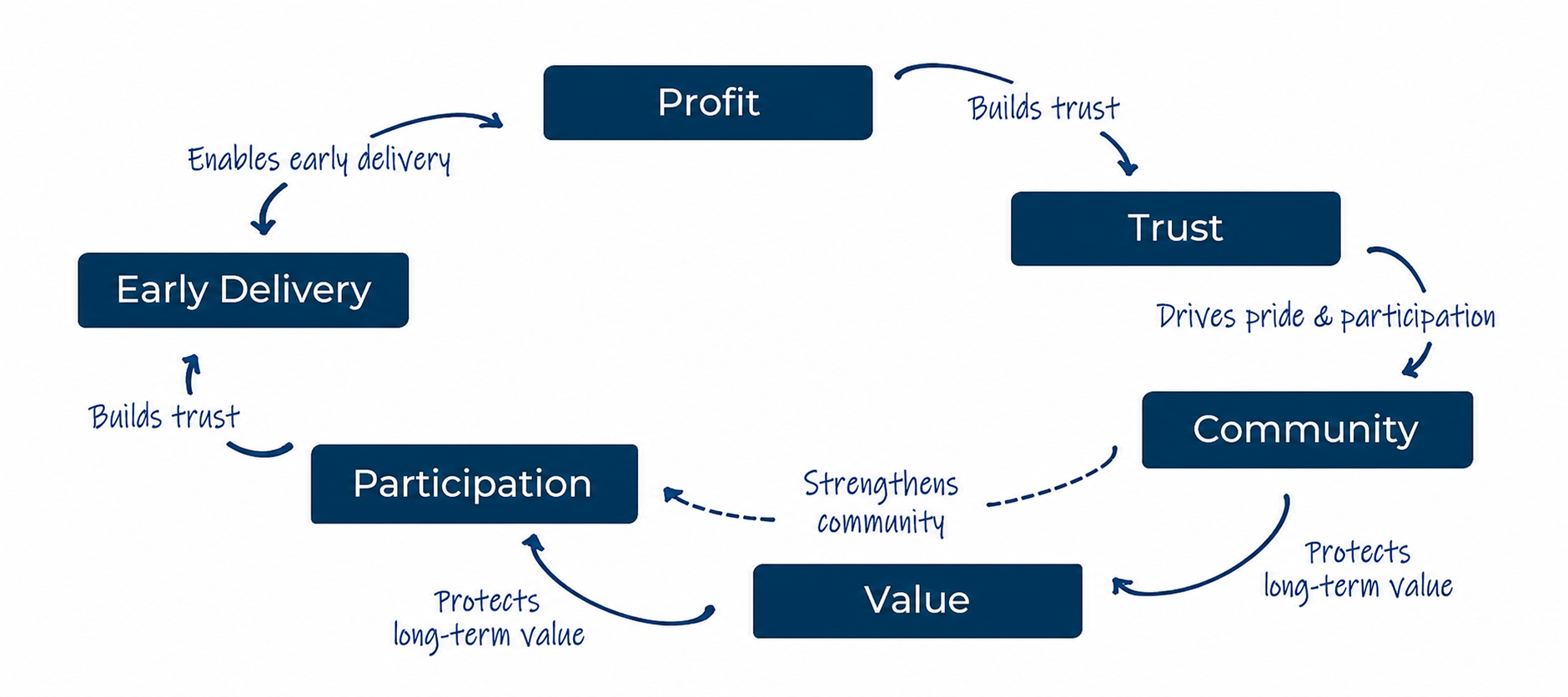
A successful project needs a clear hierarchy of goals:
1. Profit creates the capacity to deliver.
2. Delivery builds trust.
3. Trust encourages participation.
4. Participation strengthens community.
5. Strong communities protect reputation and long-term value.
When these objectives are aligned, sustainability and community investment are not additions to the commercial strategy. They become part of it.
Profit is the foundation, not the enemy
Profit matters because development cannot deliver public value without commercial feasibility.
It funds early infrastructure, quality public spaces, landscaping, maintenance, community programs and the many less visible elements that shape the experience of living in a new community.
The problem is not profit. The problem arises when short-term profit is pursued at the expense of delivery.
When projects under-invest early, the costs often reappear later through:
slower sales absorption
increased discounting
buyer hesitation
resident dissatisfaction
reputational damage
strained relationships with councils and other stakeholders.
Commercial discipline and community outcomes are therefore not opposing forces. Strong commercial foundations create the capacity to deliver on promises.
Sustainability must extend beyond the home
Enviromental sustainability remains essential. Buyers increasingly expect energy-efficient homes, solar power, efficient appliances, water management, tree canopy and infrastructure that responds to a changing climate.
These features help homes perform.
However, sustainable communities require more than technically efficient buildings. They also need to work socially.
Social sustainability is created through the everyday experience of a place:
safe lighting and pedestrian crossings
well-maintained paths and public spaces
walkable neighbourhoods
access to parks, schools and services
places where people can meet
clear and honest communication
opportunities for residents to participate.
Environmental sustainability helps homes perform. Social sustainability helps communities last.
A neighbourhood can meet every technical sustainability standard and still fail to create belonging. Conversely, a community with strong social connections may struggle if its physical environment is uncomfortable, unsafe or poorly maintained.
The two must be planned together.
Community is a value driver
Community is still too often treated as a soft outcome or a post-settlement initiative. In reality, it has a direct effect on buyer confidence and project resilience.
Research undertaken through the Good Neighbours Movement found that safety, convenience and green space are among residents’ strongest priorities.
The research also identified a substantial level of untapped willingness to participate. Many residents are already active in online community groups, while others want to contribute but have not been given an opportunity.
This matters commercially.
Community creates trust. Trust reduces uncertainty. Reduced uncertainty makes it easier for buyers to commit.
Property buyers are not simply assessing a house, apartment or block of land. They are assessing whether they believe in the future of the place.
They want to know:
Will the promised infrastructure be delivered?
Will the public spaces be maintained?
Will the neighbourhood feel safe?
Will services arrive when they are needed?
Will the developer continue to communicate after the sale?
Will this become a place people are proud to call home?
These questions cannot be answered through advertising alone. They are answered through visible delivery and consistent behaviour.
Take cues from the hospitality sector
The hospitality industry understands that people rarely judge an experience through one isolated interaction.
A restaurant may serve excellent food, but the overall experience can still be undermined by poor service, confusing bookings, long waits or an uncomfortable environment.
Property works in much the same way.
A strong product cannot fully compensate for a fragmented customer journey. The sales experience, construction communication, infrastructure sequencing, public realm and resident engagement all shape how people perceive the project.
Buyers do not separate the developer’s internal departments. They experience one place and one promise.
That is why marketing, sales, development, delivery and customer experience must operate from the same hierarchy of goals.
Legacy begins before sell-out
Legacy is sometimes discussed as though it is created at the end of a project. In reality, it is formed through hundreds of decisions made from the beginning.
Legacy is:
what residents say after the sales office closes
whether people recommend the community to others
whether they care for shared spaces
how councils remember the project’s delivery
whether future buyers trust the developer’s name
whether the place continues to strengthen over time.
Pride is not simply an emotional measure. It influences stewardship, advocacy and long-term value.
When residents feel proud of where they live, they participate differently. They look after the place, encourage connection and speak positively about their community.
The reverse is also true.
Delayed infrastructure, poorly maintained spaces and broken promises can turn short-term sales success into long-term distrust. Once that distrust takes hold, it is difficult and expensive to reverse.
Legacy is destroyed faster than it is built, often because the sequence of delivery does not match the sequence of sales promises.
Align the full project around one promise
Successful projects do not begin with a logo, advertising campaign or media plan.
They begin with clarity about what the project is trying to achieve and how each commercial and community objective supports the next.
A practical hierarchy is:
Profit enables early delivery.
Early delivery builds trust.
Trust encourages participation.
Participation strengthens community.
Strong community protects reputation and long-term value.
For development teams, this means:
test marketing promises against the delivery program
invest early in the elements that create buyer confidence
treat community participation as an ongoing process
align sales, marketing, development and customer experience
measure trust, pride and advocacy alongside sales and settlements
make infrastructure sequencing visible and understandable
continue communication beyond the point of purchase.
The projects that outperform will not necessarily be the loudest, the cheapest or the most heavily promoted.
They will be the projects that give buyers confidence that the promise of the place will become real.
The role of strategic property marketing is therefore broader than creating demand. It is to connect the commercial model, the customer experience and the long-term vision of the place.
That is how development creates not only sales, but participation, advocacy and enduring value.