
What Mystery Shopping Taught Us About the Gap Between Promise and Experience
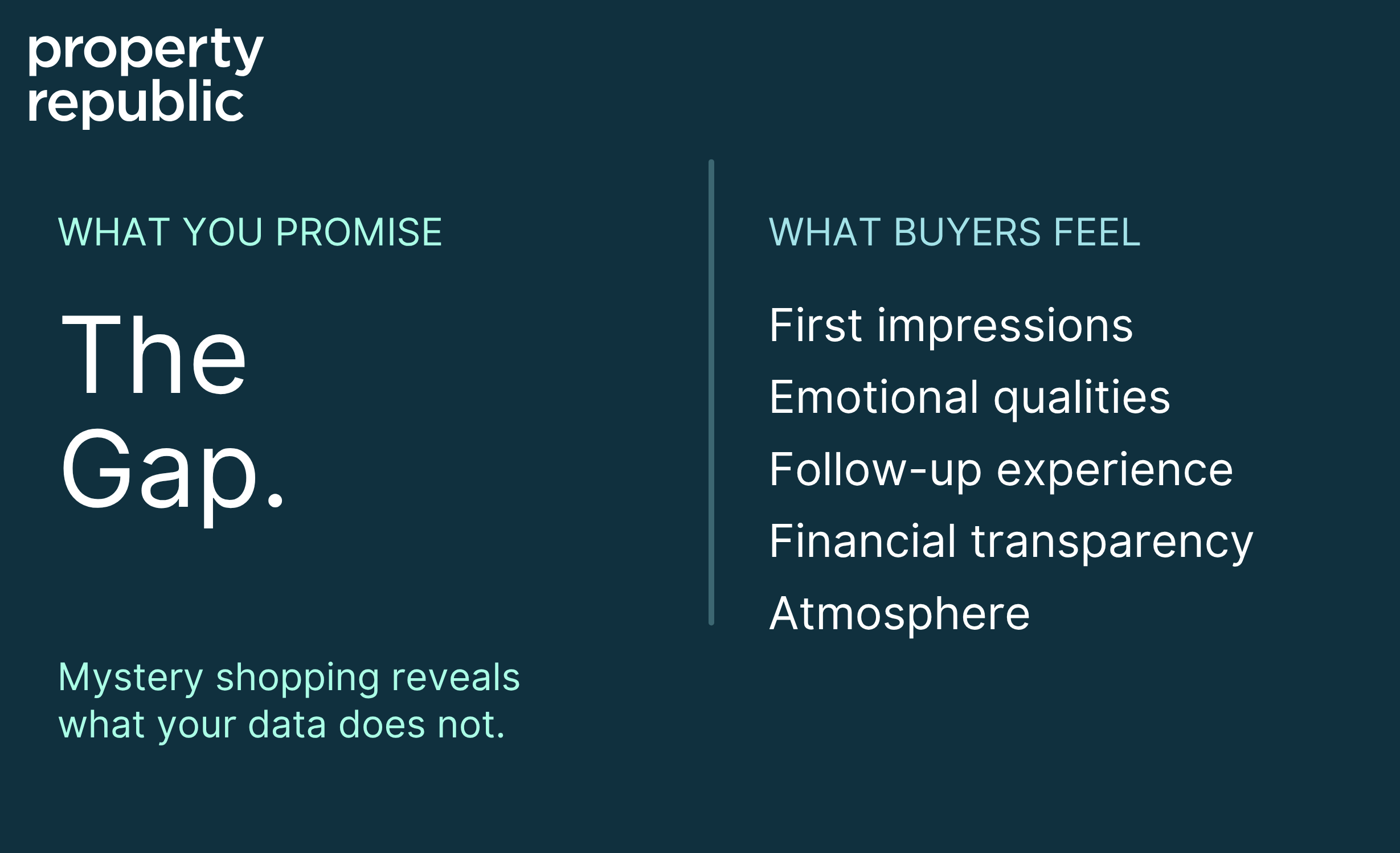
Most marketing promises more than the experience delivers. Mystery shopping makes that gap impossible to ignore.
We recently completed a detailed mystery shopping programme across a competitive market, sending trained shoppers in as genuine prospective buyers. What they found was instructive. Not because the developments they visited were doing everything wrong. But because the distance between what was communicated and what was felt was, in many cases, significant.
Here is what the research consistently revealed.
1. First Impressions Are Set Before Anyone Speaks
The physical and digital arrival experience shapes a buyer's emotional posture before a single conversation takes place. Communities that had invested in their entry sequence, their signage, their landscaping and their digital presence created an immediate sense of credibility. Those that hadn't were already fighting an uphill battle, regardless of what followed.
Recommendations:
Audit your physical arrival experience as a stranger would encounter it on a first visit, paying attention to signage clarity, maintenance, atmosphere and the transition from public space to your environment.
Review your digital presence through the same lens. Does the enquiry experience feel warm, current and responsive, or bureaucratic and slow?
Train your team to understand that the first impression is not their greeting. It begins long before that.
2. Buyers Are Asking Emotional Questions That Most Salespeople Are Not Answering
The shoppers consistently reported that sales conversations were led by product information rather than by the buyer's own situation. Features were explained. Lists were walked through. But the underlying questions buyers were carrying into those conversations, questions about whether they could imagine themselves there, whether they would feel at home, whether the decision was one they could trust, were rarely drawn out or addressed.
Recommendations:
Train sales consultants to open conversations by uncovering what prompted the visit, not by launching into a standard presentation.
Develop a short framework of emotional checkpoint questions that help buyers articulate what they are actually looking for, beyond the practical specifications.
Build follow-up communication that speaks to those emotional questions, rather than simply re-sending brochures or price lists.
3. Follow-Up Was the Biggest Missed Opportunity
Across almost every development visited, the post-enquiry experience was weak. Response times were slow. When responses did arrive, they were generic. The quality of engagement dropped sharply once the shopper had left the physical site.
Recommendations:
Implement a structured follow-up sequence that begins within two hours of an initial enquiry or site visit.
Personalise follow-up based on what was discussed during the visit, referencing specific details the buyer shared rather than sending a standard package.
Assign a named consultant to each prospective buyer and ensure continuity across every subsequent touchpoint.
4. Financial Transparency Was Rare, and Buyers Noticed
When shoppers raised questions about pricing, future costs such as building a home and what the full financial picture looked like, many developers became vague or deflected. This was not lost on the shoppers. In their responses, financial clarity was consistently cited as a trust indicator. Developers who addressed it openly were rated more favourably, regardless of whether their pricing was the most competitive.
Recommendations:
Develop a simple, plain-language document that sets out the full cost structure for a prospective buyer, removing the need for them to ask.
Train consultants to proactively address financial questions rather than waiting for buyers to raise them.
Treat financial transparency as a positioning asset, not a disclosure obligation.
The research reinforces something that applies well beyond any single market or category. The gap between what organisations promise and what buyers actually experience is where trust is won or lost. Closing that gap consistently, across every touchpoint from first digital contact to post-visit follow-up, is not a marketing exercise. It is the work of building a genuinely customer-centred organisation. The developers who understand that are not simply performing better today. They are building the kind of reputation that compounds over time.